
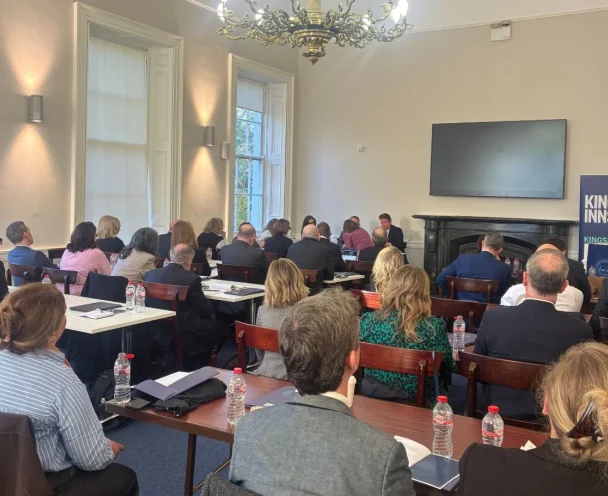
Barristers working in-house are playing a growing role in public life and business. How they can meet the demands of that role while protecting their professional independence was a central theme at the King’s Inns Employed Bar Annual Conference on 12 November 2026.
Under the title “Challenges and Opportunities for In-House Counsel”, speakers explored regulation, leadership, mediation, career change, artificial intelligence and managing risk. A common message ran through the day: early, clear legal advice matters, and professionalism, integrity and independence remain essential wherever barristers work.
A home for the employed Bar
Welcoming delegates, Mr Justice Quinn placed professional connection at the heart of the day. With a substantial number of barristers working outside the Law Library, he described King’s Inns as an alma mater where the employed Bar could build a network of its own.
He noted that the incoming Chair of the Bar Council of England and Wales was an employed barrister — a sign of the breadth of roles now represented within the profession. As that community develops, he suggested, established ways of thinking may also need to adapt.
A growing role for the employed Bar
Addressing the conference, Mr Justice David Barniville, President of the High Court, described how perceptions of in-house practice have changed. Once seen as a departure from the mainstream Bar, it is now an established and expanding career path.
He told delegates that the number of employed barristers had risen from 537 in 2013 to 1,091, linking that growth to Ireland’s development as a centre for international investment and business.
In that setting, he said, barristers can help organisations address legal questions before they become problems. Their contribution ranges from governance and commercial contracts to resolving disputes and managing risk.
Mr Justice Barniville also discussed mediation and the use of generative artificial intelligence in civil litigation, referring to High Court Practice Directions 141 and 142 of 2026. New technology and changing ways of working, he emphasised, do not alter barristers’ core professional duties.
Legal advice at the heart of public service
Attorney General Rossa Fanning SC traced the growth of the employed Bar in the public sector, from the small office supporting the first Attorney General, Hugh Kennedy, to today’s much wider network of legal roles.
Alongside his own Office, he highlighted opportunities in organisations including An Garda Síochána, the Data Protection Commission and the Oireachtas.
Drawing on the work of public leadership scholar Mark H. Moore, the Attorney General set out four questions for public initiatives: do they deliver public value, have a clear legal basis, fall within the organisation’s ability to deliver, and impose a necessary and proportionate burden?
In-house barristers, he said, can help answer those questions from the outset. That does not mean being unduly cautious. It means giving practical advice while maintaining professional independence.
He closed by turning a familiar joke from Yes, Minister on its head. Rather than arriving too late, being impossible to understand or going unheeded, advice from public sector barristers is often given early, expressed clearly and acted upon.
Knowing the client — and the limits of the role
Brian Kennedy SC examined the regulatory and ethical challenges of working in-house. He outlined the framework established by the Legal Services Regulation Act 2015, including section 212, and the professional rules that apply to employed barristers.
Working for one employer does not remove the duty to give independent advice. Brian highlighted the pressures that can arise when legal judgment meets commercial expectations.
He also explored a question that can become particularly important during internal investigations: who is the client? Employees speaking to an organisation’s lawyer need to understand that the lawyer acts for the organisation, not necessarily for them personally.
That distinction matters for legal professional privilege — the protection that can keep legal advice confidential. Brian discussed differences between the Irish and EU positions and the need to understand when that protection applies and who can waive it.
His practical message was to be clear about who the client is, whether the barrister is acting as a lawyer or in a management role, and the limits of confidentiality. Professionalism, integrity and independence should guide those decisions.
The regulator’s perspective
Niamh Muldoon, chief executive of the Legal Services Regulatory Authority (LSRA), told delegates that employed barristers were not currently a source of regulatory concern. Of 939 complaints received by the Authority, she said, 39 involved barristers and none involved employed barristers.
She discussed how the regulatory framework applies to barristers who advise an employer rather than the public. She also encouraged the in-house community to contribute as the Authority develops guidance on section 212 and considers new ways of delivering legal services.
Her wider update covered partnerships bringing together different professions, equality and diversity, legal education, and codes of practice on residential tenancies and conveyancing.
Looking ahead, she identified six challenges for regulation:
Different expectations among five generations of lawyers working together.
The rapid growth of artificial intelligence.
The future of rural practice and areas with limited access to lawyers.
New complaints involving online scams and social media.
Continuing barriers to access to justice.
Professional isolation, changing working patterns and new legal structures.
She returned to the principles heard throughout the morning: professionalism, integrity and independence apply equally to in-house lawyers and those at the independent Bar.
Making the move into in-house leadership
The focus then shifted from regulation to experience. Executive coach, mentor, facilitator and mediator Hannah Carney joined Diane Duggan to discuss the move from self-employed practice into an in-house leadership role.
After 18 years at the Irish Bar, Diane became Head of Legal Supervision and Enforcement at the Electoral Commission. She described seeking guidance from Hannah and others as she prepared for the change.
The transition required a different working rhythm. Instead of the peaks and troughs of self-employed practice, there was an ongoing flow of work, alongside a greater need for planning, organisation and understanding the institution.
Diane described the importance of learning how her new team worked, building relationships and giving herself time to settle in. In-house leadership, she found, called for a longer-term view and an understanding of the wider public service.
Her four practical lessons were simple: trust the process, ask for help, invest in working relationships and take the time.
Making mediation work
Mark Connaughton SC opened the afternoon with practical guidance on mediation and the role in-house barristers can play in helping parties reach agreement.
He described a move away from treating mediation as a box-ticking exercise towards more meaningful engagement. Discussing judicial encouragement and the legal framework, he stressed the importance of a genuine willingness to take part.
His advice centred on careful preparation:
Assess the case early. Understand the main issues, the organisation’s position and where compromise may be possible.
Check authority to settle. Establish who can approve an agreement and make sure the necessary authority is in place.
Agree confidentiality arrangements. Be clear with the mediator about what can and cannot be shared.
Choose documents carefully. Bring material that helps resolve the dispute, rather than treating mediation as a way to gain an advantage in litigation.
Consider tax and costs. Address the financial implications of a settlement before agreeing terms.
Help the mediator understand the dispute. A shared set of documents can be useful, while a separate confidential note can explain sensitive issues and possible barriers to agreement.
Mark also outlined how the legal rules on mediation and costs can encourage settlement. His overall message was practical: realistic preparation, clear authority and candid engagement give mediation a stronger chance of success.
Supporting career moves and returns to practice
In a session on career moves, Sam Mercer and Genevieve Harris explored the experiences of barristers moving between roles or returning after a career break, and the support that can help them succeed.
The session examined retention and career progression in England and Wales, identifying the period around ten years after qualification as an important point at which barristers may leave practice.
Genevieve described her own path from criminal defence to an in-house Crown advocate role, back to chambers and later through a career break. She challenged the stigma sometimes attached to leaving self-employed practice and highlighted the financial obstacles that can make returning difficult.
She also discussed work through Middle Temple’s Talent Retention Working Group to develop mentoring, legal refresher sessions and wellbeing support for returners — an approach subsequently taken up by other Inns of Court.
The session ended with four practical recommendations:
Refresh job-hunting skills, including CV writing and preparation for competency-based interviews.
Build networks and seek opportunities to shadow colleagues or gain work experience.
Broaden experience through pro bono work and junior briefs, and ask for help.
Support colleagues making similar career changes.
AI in practice: opportunity with responsibility
The practical uses and risks of artificial intelligence came into focus in a panel chaired by Rachel Tobin BL of Crescendo, with Donna O’Toole of Newcode AI, Stephen Dowling SC of TrialView and Robert O’Reilly BL.
Donna outlined how AI can help with email triage, reviewing briefs, drafting and searching large collections of documents. Alongside those possibilities came questions about where information is stored, how it is protected and whether material submitted to a tool remains confidential.
Stephen described TrialView’s development from a way to collaborate on trial preparation and present documents in court. Security was not a new concern, he said, but AI was bringing it into sharper focus. The panel also discussed the growing volume of material that AI-assisted litigation could generate, including in cases involving people representing themselves.
Robert emphasised that technology does not replace a barrister’s responsibility to understand the brief and check the material relied upon. Cases suggested by AI need to be checked not only for existence but also for relevance. The discussion also highlighted the danger of tools that reinforce a user’s assumptions rather than challenge them.
A recurring distinction was between using AI to assist with information and allowing it to make decisions. The panel urged care over confidentiality and legal professional privilege, transparency about AI use when asked, and continued ownership of the final work. Efficiency, in other words, does not remove professional responsibility.
Advising when the rules pull in different directions
How to give useful advice amid overlapping regulatory demands was the focus of a discussion with Helen Whately of Meta, Hannah Smith of the General Pharmaceutical Council and Darren Dunn of GXO Logistics.
Helen, whose career had taken her from the Bar to ComReg and then Meta, described the tensions that can arise between privacy, cybersecurity and lawful access to information. Different rules can point an organisation in different directions, leaving in-house lawyers to help colleagues navigate the uncertainty.
Hannah approached the issue from a regulator’s perspective. A decision in one case can shape expectations in others, she explained, making clarity about roles particularly important. Lawyers need to know who is advising, who is deciding and where responsibility sits.
She also stressed the importance of documenting the scope of advice and the decisions taken. Relying on institutional memory alone carries a risk: knowledge can disappear when the people who hold it leave.
Darren highlighted the need to adapt when events overtake a plan. Parallel workstreams and continuing communication can help maintain momentum, while legal training provides a foundation for making decisions and explaining them to questioning audiences. Across the discussion, the trusted adviser emerged as someone who brings clarity without pretending that ambiguity has disappeared.
Building connections across the profession
Closing the conference, Mr Justice Quinn returned to the value of meeting colleagues and sharing experience. He invited Simon Regis of the Bar Council of England and Wales to reflect on the common ground between the two jurisdictions.
Simon highlighted the breadth of work undertaken by employed barristers and the opportunities to learn from one another. Employment, he stressed, does not make a barrister less independent — whether the advice is given to government or elsewhere. Continued links between the two professions could help support Ireland’s developing employed Bar.
Mr Justice Quinn described King’s Inns as a home for that community. Looking ahead, he raised the possibilities of an Employed Barrister Awards Dinner, a new association and further continuing professional development. A survey would seek views from employed barristers on what support they wanted.
Thanking the Under-Treasurer, committee, speakers and attendees, he brought the formal proceedings to a close before a drinks reception and dinner.
Across the conference, speakers presented in-house practice as a growing and varied career path. The challenge is to combine sound legal judgment with an understanding of the organisation — while keeping professional independence at the centre of the role.