

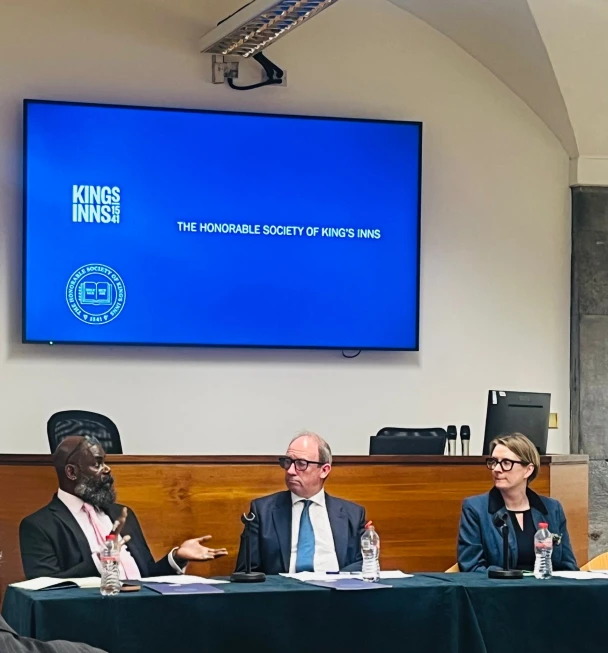
The Graduate Members Event held on the 30 April 2026 was opened by the President of the High Court, the Hon Mr Justice David Barniville, who said that employed barristers are playing an increasingly important role across government, regulation and major industries, yet still remain too often at the margins of the profession’s traditional structures.
He highlighted both the opportunities and the pressures of in-house practice: employed barristers can influence decisions at an early stage, develop deep specialist expertise and benefit from greater financial security, but they must also navigate distinct ethical challenges relating to independence, accountability and institutional loyalty.
President Barniville argued that, although employed and self-employed barristers work in different settings, they are guided by the same core professional values and should be recognised as part of one profession. He also welcomed the new efforts and initiatives led by the Graduate Members Committee, under the stewardship of Justice Oisin Quinn, to reconnect employed barristers with King’s Inns and the wider Bar.
Chaired by Judge Oisin Quinn, we were delighted to welcome Hannah Smith, Principal Lawyer with the UK Pharmaceutical Council and Simon Regis, Chair of the Bar Council of England and Wales Employed Bar Committee to our latest Graduate Member event in King’s Inns.
THE SPEAKERS
The speakers made the case that employed barristers are no longer a professional side note but a significant and growing part of the legal landscape. Drawing on experience in Ireland and England and Wales, they described a branch of the profession that now works at the centre of government, regulation, business and public administration, from advisory roles in government departments and regulators to legal teams in major technology, pharmaceutical and financial services companies. Yet, despite that growing footprint, employed barristers can still find themselves under-recognised within traditional barrister structures. The discussion returned repeatedly to a single idea: employed and self-employed practitioners may work in different settings, but they remain part of one profession governed by the same standards of independence, integrity and ethics.
One of the clearest messages from the speakers was that the Employed Bar is becoming increasingly visible and influential.
Barristers now work across government departments, regulators, professional bodies, major companies and public institutions, often shaping decisions long before disputes ever reach a courtroom. The role of barristers in bodies such as the Central Bank and in multinational sectors such as technology, pharma and aircraft leasing, while noting that employed barristers account for roughly one-fifth of the profession in England and Wales. But that growth has also exposed an old divide. Barristers who move into employment can lose touch with the self-employed Bar and with institutions such as King’s Inns, even though their experience and expertise have much to contribute. The answer proposed was not separation but stronger recognition of a shared professional identity, summed up in the phrase “one Bar”.
The speakers also painted a detailed picture of the pressures that can come with practising from inside an organisation. For employed barristers, ethical issues may arise not only from the law itself but from proximity to decision-makers, internal politics and the challenge of preserving professional independence while working as part of a wider institution. Questions about who the client really is, how legal risk should be communicated, and what happens when advice is heard but not followed all featured prominently. Hannah described the difficulty of advising in a non-legal organisation where legal considerations may be only one factor among many, while Simon highlighted the pressure that can fall on a sole lawyer in a private organisation if management expects legal advice to justify a preferred outcome. The discussion also touched on the importance of clear escalation routes, especially in government settings, and on the need for support where barristers may feel professionally isolated. Yet the speakers were equally clear that these pressures do not dilute professional obligations: the same duties of honesty, independence and accountability apply, regardless of whether a barrister works in chambers or in-house.
HIGHLIGHTS
If the discussion highlighted challenge, it also pointed to practical solutions. The speakers described how the employed Bar in England and Wales has built visibility through dedicated committees, newsletters, ethics guidance, forums and representation in governance structures. Examples included the Employed Bar Committee of the Bar Council, regular contributions to Counsel Magazine, quarterly newsletters, and efforts within the Inns of Court to ensure employed barristers are represented on working groups and governance bodies. Simon described an Employed Bar forum at Inner Temple that hosts events highlighting the range of careers open to employed barristers, from regulatory work to senior public service roles. Networking was presented not as an optional extra but as a way of countering professional isolation, sharing ethical experience and helping newer barristers see alternatives to the traditional self-employed model. For King’s Inns, the message was clear: if employed barristers are to remain fully connected to the profession, institutional support must be deliberate, sustained and designed with their needs in mind.
Overall, the event presented the employed Bar as a profession within a profession: increasingly central to legal and public decision-making, but still working to secure full recognition of its voice and experience.
Across the discussion, the dominant themes were visibility, ethical resilience, professional identity and the need for stronger structures of representation and support. The speakers combined practical examples with a broader institutional challenge: how to ensure that barristers working in-house, in regulation, in government or in business are not seen as peripheral to the profession but as an essential part of its future. The tone was both reflective and practical, with speakers arguing that the future strength of the profession will depend in part on how fully it embraces the contribution of barristers working beyond the traditional model of practice.